Basil, the king
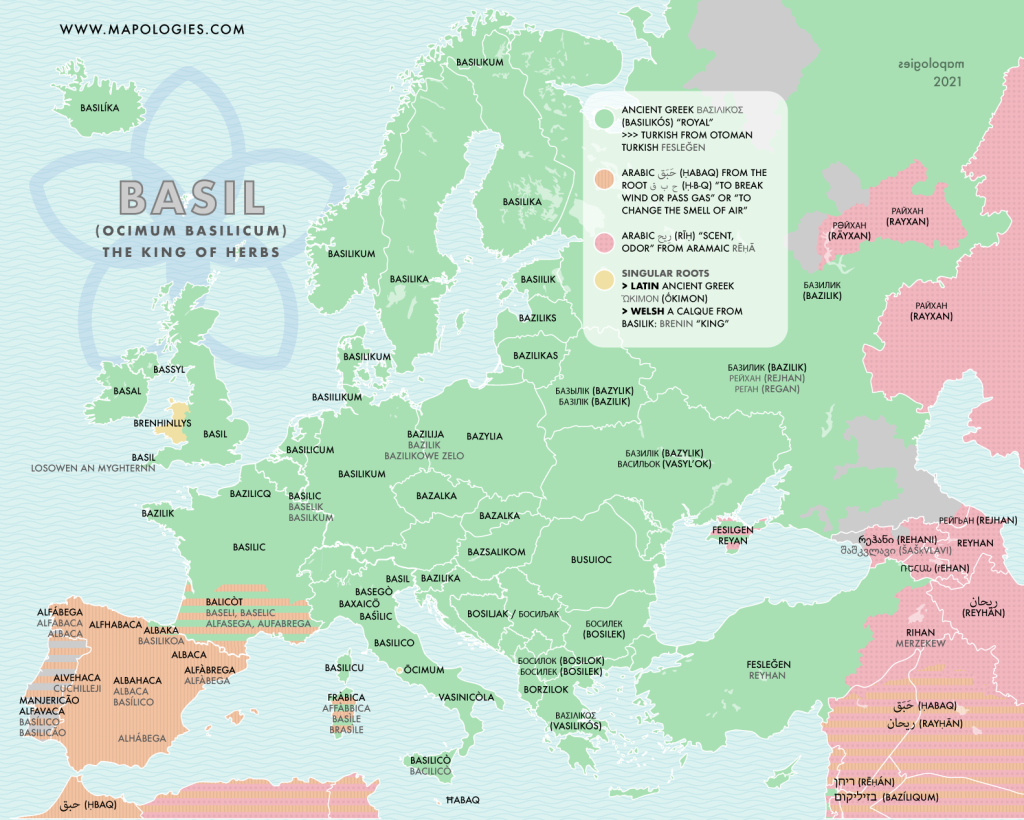
This etymology map is about the names of one culinary herb, basil. It comes from βασιλικόν φυτόν (basilikón phutón) “royal (plant)” in Ancient Greek. The word basileus was very bountiful, produced a lot of descendants. Apart from the plant, we can mention basilica, the catholic temple, which originally was meant to be a court of justice, in Greek (stoa) basilike “royal (portal)”. The Swiss city of Basel and the Italian region of Basilicata are also members of this long list. The city name originated from a toponym villa Basilia “estate of Basilius” and the region was named after the basileus, the Byzantine emperor. Surprisingly the mythical serpent basilisc also comes from Greek basiliskos “little king”. In the real world, the common basilisk (Basiliscus basiliscus) is a lizard from Central America and South America. This is because people used to say that basiliscs wore a crown-shaped crest or maybe a mitre. Finally, the names Basile, Basilio, Vasyl, or Vasilis come from the male Greek name Vassilios. Did we forget any other words?


Coriander
Dill, the aroma
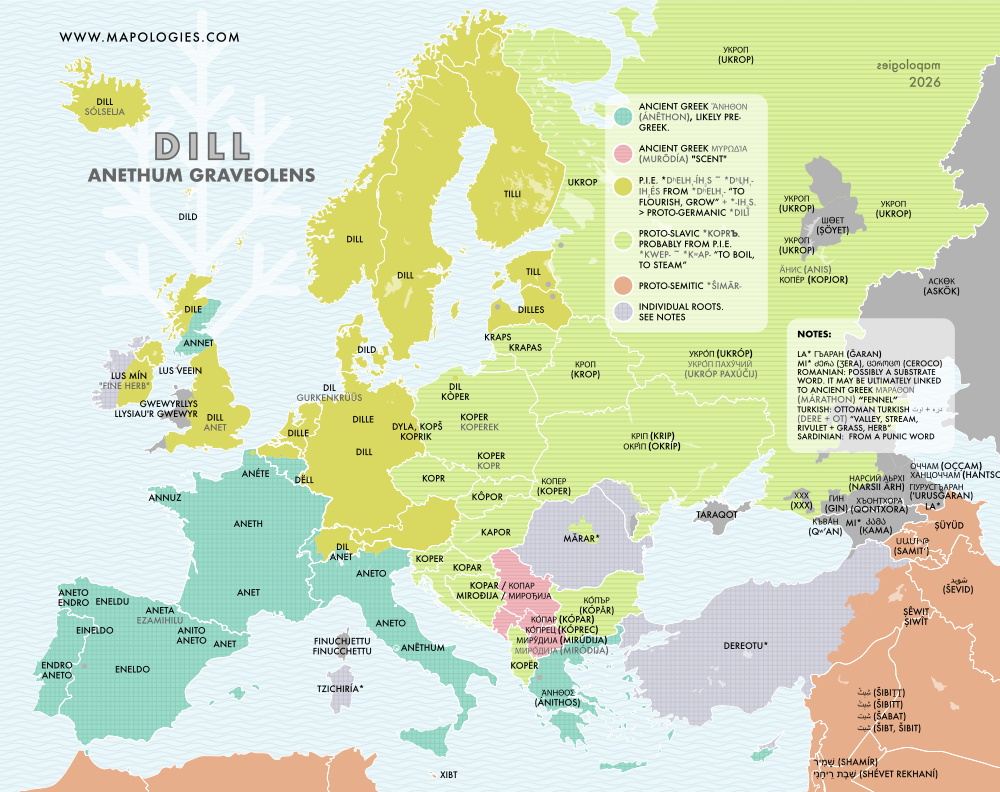
Dill originated in North Africa, Iran, and the Arabian Peninsula. The name in these regions is Semitic, such as Arabic شبت (šibitt) and Azerbaijani şüyüd. In Europe the plant’s name falls into three main groups. The first group is Germanic-derived, giving English, German and Swedish “dill“. This root also appears in some non‑Germanic languages, for example Latvian dilles. The second group comes from a Slavic root, копрь (koprĭ) “to boil, to steam” — e.g., Russian укроп (ukróp), Polish koper. The original meaning of the was likely “the aromatic one”. The third group derives from two Greek roots: First ἀνῆθον (ánēthon), which survives in Modern Greek as άνιθος (ánithos) and in several Romance languages such as French aneth, Italian aneto, and Asturian eneldo; and second μυρωδιά (myrodiá, “scent”), which appears in Serbian and Macedonian as миродија (mirodija).
Fennel, the runner

Often etymologies can be intricate. Even though the map of Fennel (foeniculum vulgare) looks very homogenous it has a very interesting story behind it.
The Greek word is different from other languages, but even more puzzling is that is similar to marathon. Why? Because this was the name where a famous battle took place during the first Persian invasion of Greece in 490. It seems that the place must be covered in fennel.
The myth is about Pheidippides, the Athenian runner, going from Marathon to Athens after the battle to bring the news of the Athenian victory, to die of exhaustion on arrival. However, according to historical sources, he was asked to run from Athens (not to Athens) to Sparta. The aim was to ask for assistance before the battle, not after. That is 225 km. The famous 42 km is approximately the distance that the Athenian army made after the battle chasing the Persians.
In our era, the modern marathon race was an idea from Michel Bréal during the first modern Olympic Games in 1896 in Athens.


Parsley, the rocker

Greeks left us a significant heritage of words in modern languages. A good example is parsley, which has a double etymological root. The English word, like in many other languages, can be traced back to Ancient Greek, where it was called πέτροσέλινον (petroselinon). This roughly translates to “rock celery,” probably because it was thought to be a remedy for calculi (kidney stones).
The other main root is also Greek, μακεδονήσιον (makedonision), meaning “the Macedonian herb.”
Then, of course, there are many individual roots that only appear in specific languages.
Lemon balm, the beekeeper

Since Lemon balm belongs to the same family as mint, they are often confused. Lemon balm however has a peculiar lemon-mint scent, giving the plant its common name. The same in Portuguese and Hungarian, and the popular names in many other languages (for example, Dutch and Italian cintronella). Catalans and Arabs, however, disagree on this, for them, it is more orange-like (tarongina and turunjan respectively).
In English, it is known also as “heart’s delight”. Languages colored in pink, the Scandinavian languages, and also German popular names, refer to the fabulous healing properties of this herb. The alchemist Paracelsus even said that this plant is the “elixir of life”.
On the other hand, some languages called it “Lemon melissa”. Melissa is a Latin word (the botanical name is Melissa officinalis) but it comes from Greek: μέλισσα. It means honey and also honey bee. In English, it does exist mellifluous and melliferous, which share the same origin, from Proto-Indo-European *mélid.
Most languages have this name or one derived from the Greek word. But the idea of the connection between honey and lemon balm is lost. Except in languages like Czech and Slovak that use a calque derived from med “honey”.
Some other languages, the green ones, associate it with bees and the plant’s ability to attract them. In the Balkans, for example, Albanians say bari i bletës means “herb of bees” and Romanians call ti roiniță, which comes from roi “swarm” (from Proto-Slavic ròjь). The South Slavic languages use similar words, all of them come from the word queen bee, mati “mother“.
The association with bees comes from Antiquity. Beekeepers by crushing the leaves of lemon balm, release their essential oils, and make bees swarm around. The explanation is that some of those chemicals are similar to certain pheromones released by worker bees to orient themselves, known as Nasonov. Synthetically produced Nasonov consists of citral and geraniol.


Mint, the ancient

It can have many names: Menta, Minze, Menthe, Mjata, but all of them refer to Mint. The origin of this word is Greek: μίνθη (mínthē) or μίνθα (míntha). This name is pretty widely spread but we can find other names on the map: Turkish nane, Macedonian нана (nana) or Arabian نَعْنَاع (naʕnāʕ) looks similar because they shared the same root: Hurrian *an-an-uḫḫə or *an-an-uγə.
Sage, the healthy
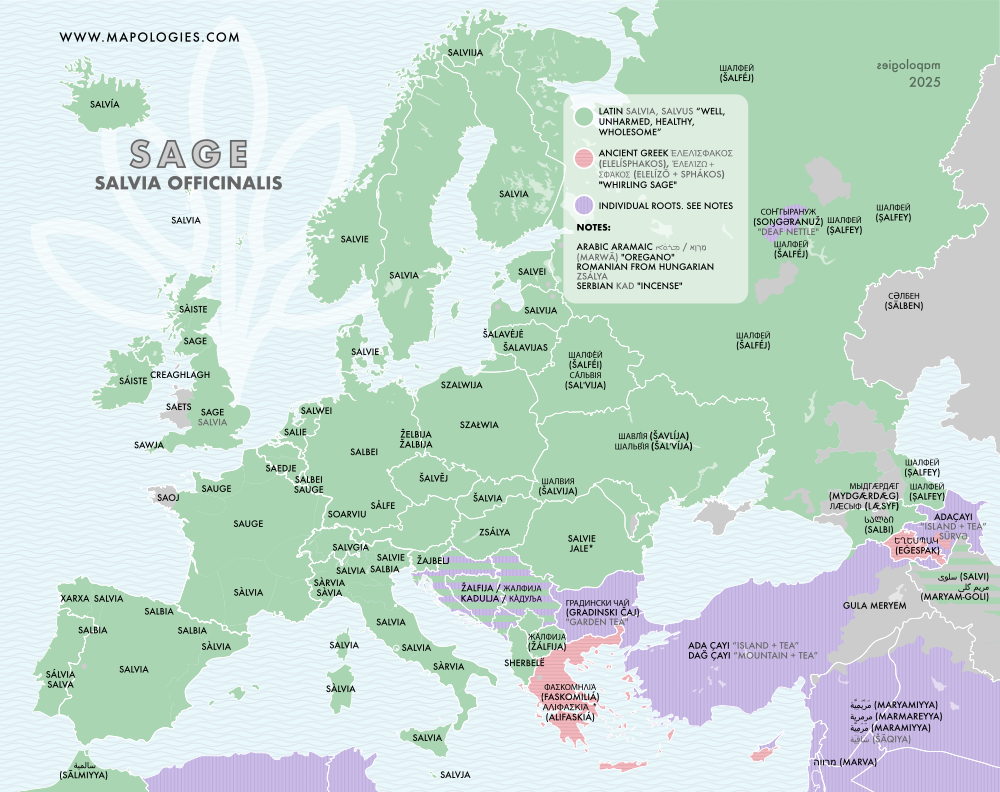
The English word sage was borrowed from the French sauge, which evolved from the Latin salvia. This name comes directly from the adjective salvus, meaning “well” or “unharmed”—a literal tribute to the plant’s legendary medicinal properties known since antiquity. Today, Spanish, Italian, Swedish and even Finnish know it still as salvia.
Travel east, however, and you find a completely different linguistic branch. The modern Greek name αλιφασκιά (alifaskiá) and the Armenian եղեսպակ (eġespak) both trace their ancestry back to the same source: the Ancient Greek word ἐλελίσφακος (elelísphakos). Meanwhile, the Arabic world took a beautiful, more spiritual approach. Across most of the region (with the exception of Morocco), sage is known as مَرْيَمِيَّة (maryamiyya).
Tea, the bitter

The word “tea” takes on various forms in different languages, yet they all trace their origins back to the Chinese character for tea 茶. In English and most Western languages, the term arrived thanks to the Dutch commercial routes: “tea” is derived from “thee.” This Dutch word has its roots in Hokkien 茶 (tê), from ancient Chinese and Proto-Sino-Tibetan *s-la, meaning “leaf, tea.” Similarly, the Portuguese word “cha” has connections through Cantonese 茶 (caa4), still linked to the shared ancient source *s-la. Many Eastern languages have terms resembling the Portuguese “cha,” often arriving via the Persian route. Notably, in Polish the term originally referred to “tea herb” from Latin word “herba thea.”
Despite the linguistic variations, these terms all share a common origin in the Chinese word for tea. This linguistic connection also extends to the scientific name “sinesis“. This intricate web of etymologies sheds light on the rich history of global interactions surrounding tea and reflects the complexities of historical trade, commercial routes, and colonialism.
Thyme, the smoker
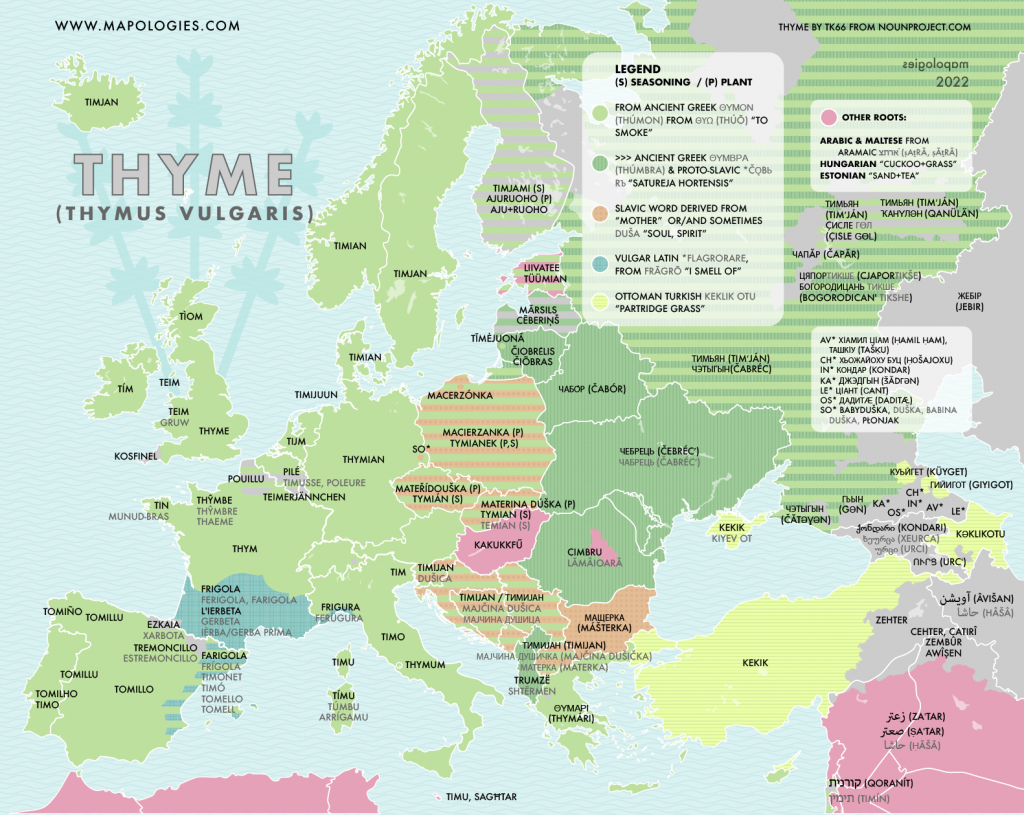
θύμον (thúmon) in Ancient Greek refers to thyme, and you can see that we still use it today. In French, it is “thym,” and in Swedish, it is “timjan.” What does it mean? Sometimes, we are just not sure. Some suggest that it comes from a pre-Greek word that simply refers to the plant. However, others have proposed something very interesting: what if it derives from θύω (thúō), meaning “to smoke“? Thyme has been burned to release its esences into the air since antiquity. It could be.
In other languages, the etymological meanings are no less interesting. Many Slavic languages derive it from the word for “mother.” For example, we have Slovak (materina dúška) or Bulgarian (мащерка, mashterka). On the other hand, Catalan (farigola) and Occitan (farigola) derive from the verb “to smell” in Latin. Finally, some individual languages are worth mentioning. Hungarian (kakukkfű) means “cuckoo’s grass,” and Estonian (liivatee) is composed of “sand” (liiv) and “tea” (tee).