In this post, we will analyze the etymological roots of words used to define materials and secretions derived from non-human animals. Specifically, we will trace the linguistic histories behind everyday terms like meat, fat, blood, milk, eggs, and honey.
Blood
Blooming Poppies
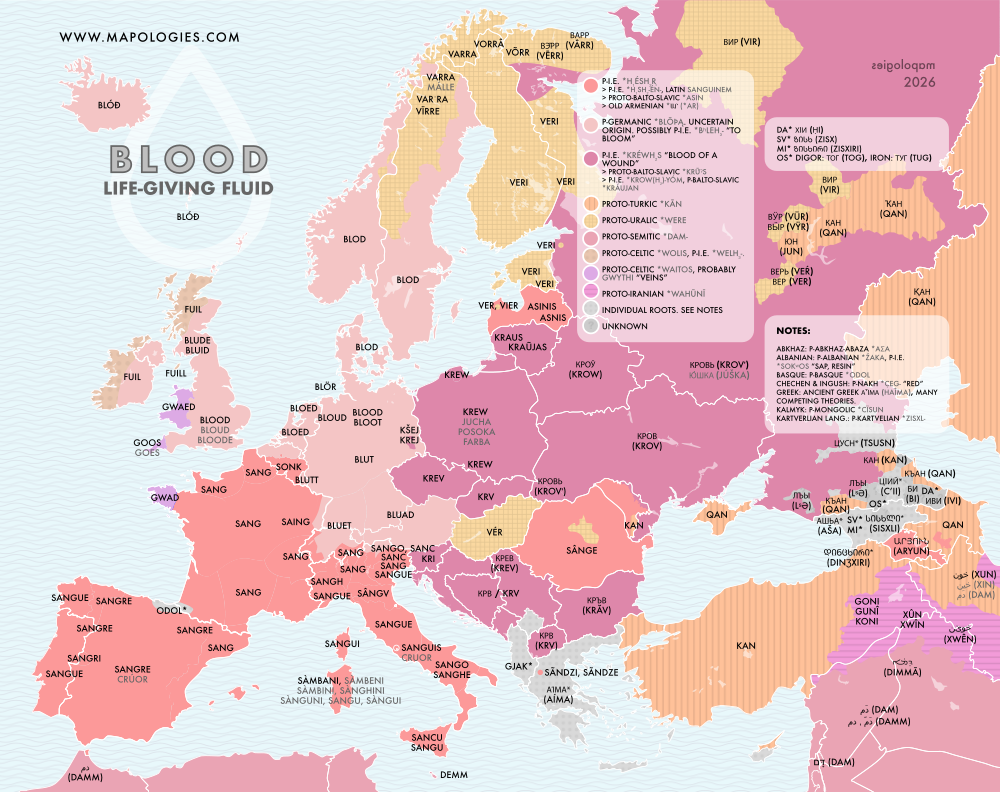
In English, blood comes from the Proto-Germanic word blōþą. It is related to words such as German Blut, Dutch bloed, Swedish blod, Danish blod, and Icelandic blóð. Its deeper origins are uncertain, but some scholars connect it to the Proto-Indo-European root bʰleh₃-, meaning “to bloom”—a rather beautiful association for something so essential to life.
In and Out
The Romance-language words—Spanish sangre, French sang, Italian and Portuguese sangue, and Romanian sânge—all descend from the Latin forms sanguis or sanguinem. Their influence persists in English words such as sanguine and sanguinary. Ultimately, these Latin terms can be traced to a Proto-Indo-European root, giving them distant cousins such as Armenian արյուն (aryun) and Latvian asinis.
However blood has two ancient Indo-European roots, depending on whether it was found inside the body or outside it, as in a wound. The root h₁ésh₂r̥, meaning blood within the body, gave rise to the Latin word sanguis. The second root, kréwh₂s, referred to blood spilled from a wound. It became associated with ideas of rawness and brutality. Its distant descendants may be heard in English words such as raw, crude and cruel. It first evolved into Balto-Slavic krū́ˀs and later into Proto-Slavic krъvь. Its descendants can still be found today in Russian кровь (krovʹ), Polish krew, Czech krev, Ukrainian кров (krov), and Serbo-Croatian krv.
Container-for-content metonym
Welsh gwaed, Breton gwad, and Cornish goos come from the Proto-Celtic word waitos. This word may ultimately be connected to gwythi, meaning “veins.”
Egg
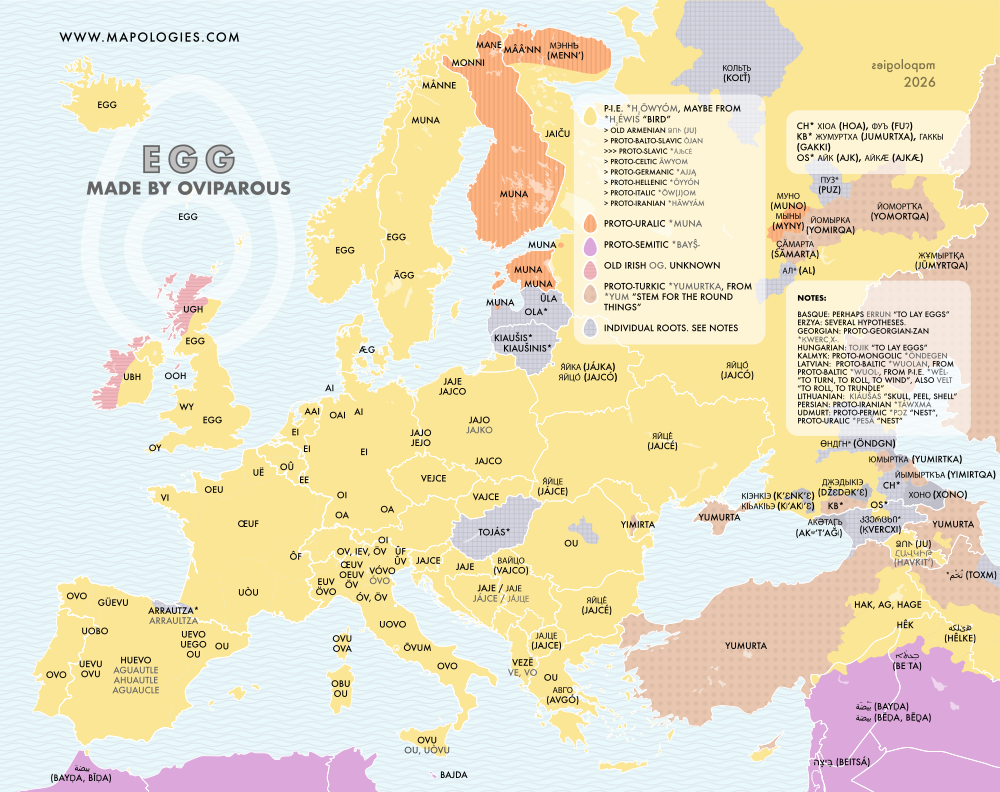
This is a clear case of a widespread root featuring a fascinating variety of phonetic changes. Words like ovo, ei, ou, kek, and jaje all mean “egg” and trace their origins back to the Proto-Indo-European *h₂ōwyóm. To see where this root didn’t take firm hold, it helps to look at the outliers. In Celtic languages, forms like Irish ubh, Manx ooh, and Scottish Gaelic ugh might derive from *h₂ōwyóm, but the evidence isn’t entirely clear. Meanwhile, Baltic languages are also missing. They diverged completely through independent innovations—Latvian settled on ola, and Lithuanian developed kiaušinis (literally stemming from kiáušas, “shell” or “peel”).
Feather
Honey
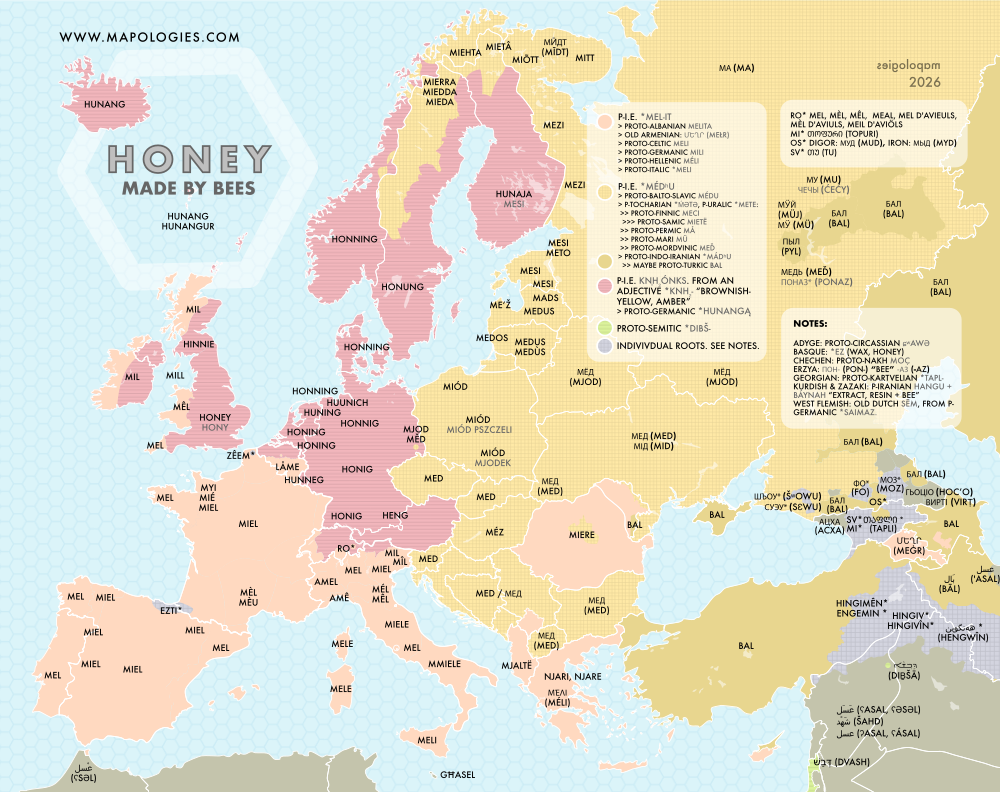
Honey has an interesting distribution of etymological roots across languages. Serbian med, or мед, is not etymologically connected to Portuguese mel, despite their apparent similarity, but it is distantly related to Turkish bal. We might expect med to relate to other Slavic terms such as Polish miód, and it is also connected to the adjacent Hungarian méz and, farther away, Komi ма (ma). These languages ultimately derive from the Proto–Indo-European root medʰu ‘honey’.
By contrast, Portuguese mel is connected not only to other Romance languages—such as Romanian miere—but also to Albanian mjaltë, Greek μέλῐ (mélĭ), Armenian մեղր (meġr), and Irish mil. The origin here goes back to another Proto–Indo-European mel-ty.
A third group traces back to a different Indo-European root, *kn̥h₂ónks. Its main descendant in Proto-Germanic is hunangō, which yields English honey and also related Germanic words such as Swedish honung and German Honig. We should also include one non-Germanic language in this third group: Finnish hunaja, which borrowed the word via Swedish.
Curious where the word “bee” came from? Click here to find out. Did you know that a traditional herbal plant is often linked to bees and honey. Which one?
Leather
Meat
Flesh or meat?
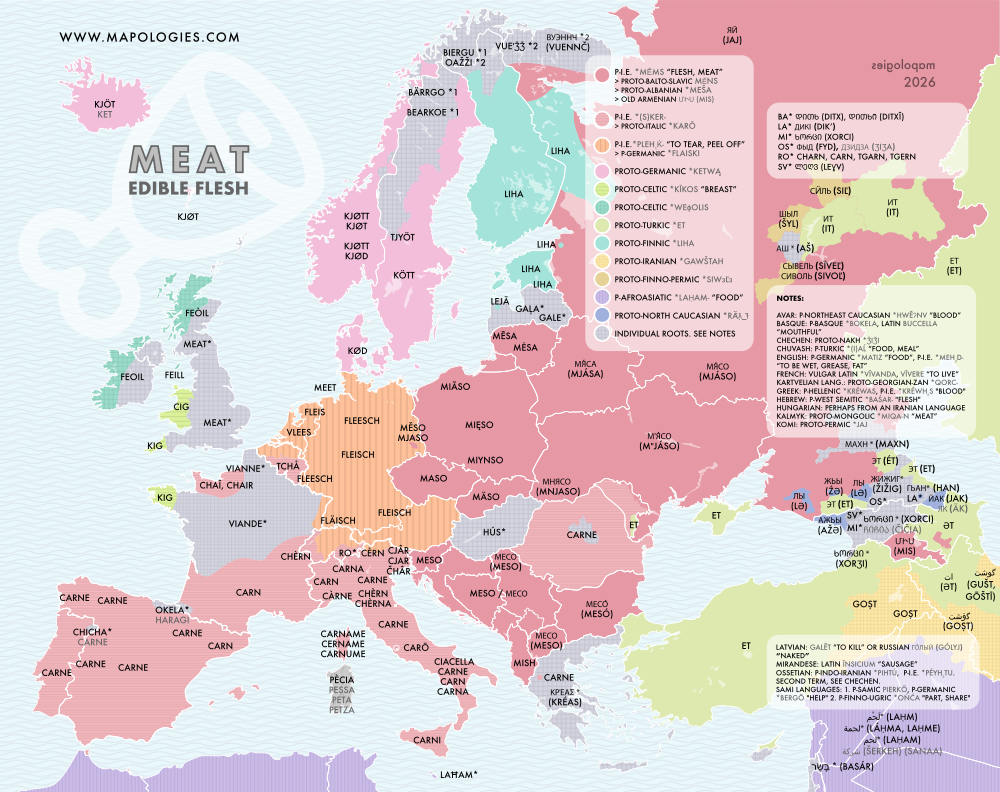
The soft substance made of muscle and fat found between an animal’s or a human’s skin and bones is generally called flesh. In this image, we use a more specific definition: flesh as it relates to animal origin used for food, i.e., meat. In everyday or colloquial contexts, fish flesh is usually not included in this definition of meat. Not all languages make this same distinction with separate terms. Some languages do have a clear flesh/meat pair, such as: Icelandic, hold / kjöt, or French, chair / viande.
In terms of historical roots, flesh has related forms (cognates) in other Germanic languages, like Dutch vlees and German Fleisch, where the meaning can be both flesh and meat. These words are traced to Proto-Germanic *flaiski. By contrast, other Germanic languages used different roots for the “meat” word, derived from Proto-Germanic *ketwą: Swedish kött, Danish kød, and Norwegian kjøt. Finally English meat originated from a third root: Proto-Germanic *matiz “food”.
Milk
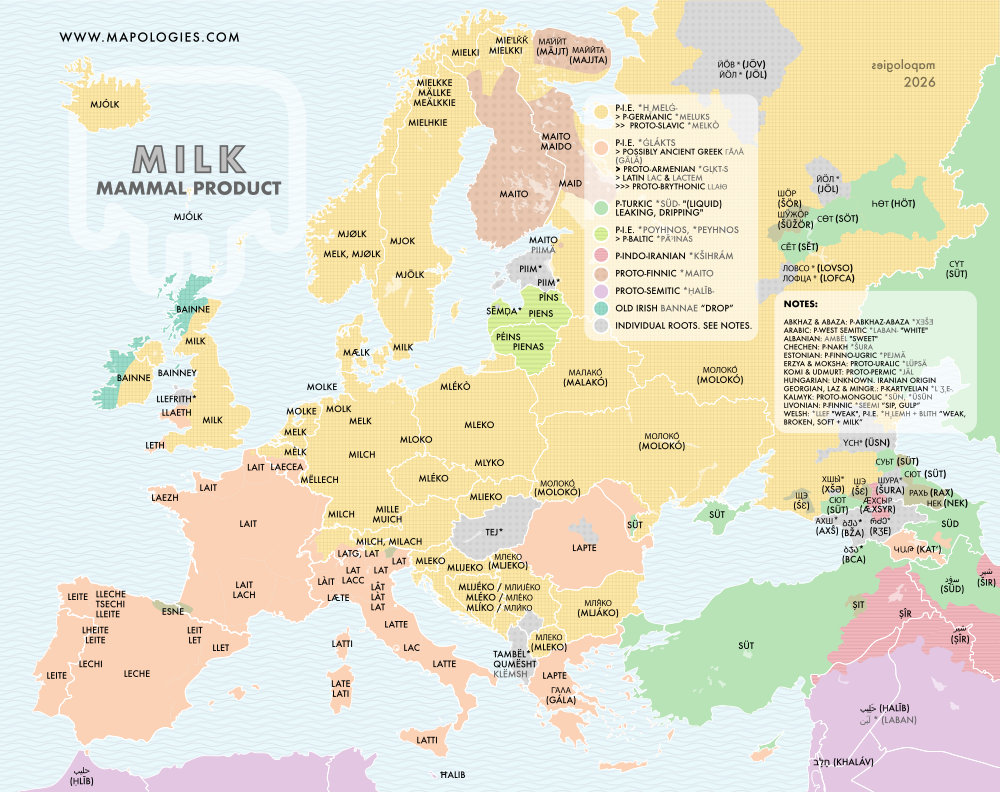
It is quite simple to conclude that the English word milk emerged from a common ancestor shared with the German Milch, Dutch melk, and even the distant Icelandic mjólk. This is because they are all Germanic languages that share the Proto-Germanic root *meluks. There is more to see. It is also easy to see that languages from entirely different language families are remarkably similar. Look at Macedonian mleko (млеко) in the south (a Slavic language), or Northern Sámi mielki in the far north (a Uralic language). As the map showcases, most words for milk in Europe descend from the Proto-Indo-European root *h₂melǵ-.
However, the other half of the continent inherited their words from a completely different Proto-Indo-European root, *ǵlákts. This root gave rise to an incredibly diverse group of descendants, including: Galician: leite, Welsh: llaeth, Greek: gála (γάλα) and, Armenian: kat’ (կաթ) Can you believe such a diverse group of languages came from the same source? Meanwhile, it is a totally different story with the Turkic languages. Their words for milk have changed very little over the millennia, tracking in a direct line from the Proto-Turkic *süt to the modern Turkish süt and Chuvash sĕt (сĕт).
One last question: Which astronomical object is connected etymologically to milk? Click here to find out.
Silk
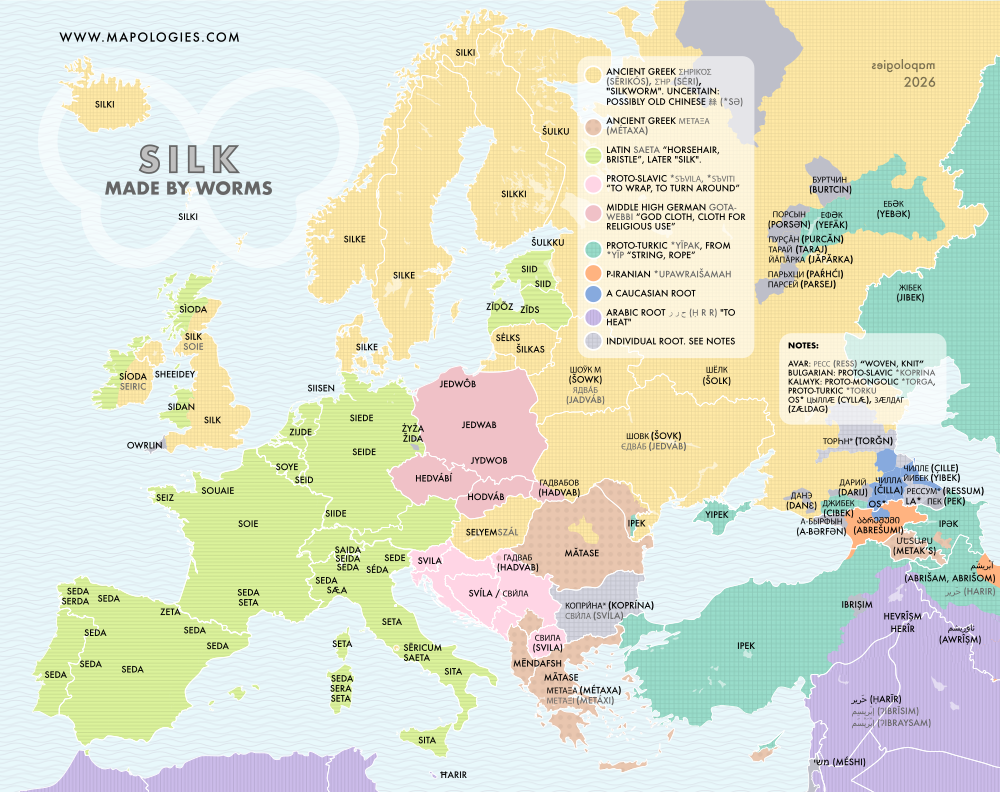
Untangling the Linguistic Silk Road
Few materials have traveled as widely as silk. Moving from one end of the Eurasian continent to the other, it carried not only wealth and prestige but also the words used to name it. The English word silk ultimately derives from Latin sēricum, which was borrowed from Greek sērikón. The Greeks associated this term with the Seres, an eastern people known as suppliers of the precious fabric. The name is generally traced further back to Old Chinese 絲 (sə), meaning “silk.”
For millennia, silk production was closely guarded, while the finished fabric traveled across enormous distances. Its rarity, restricted manufacture, and high cost made silk a symbol of wealth and status. This value is reflected in the diverse histories of the European words for silk. The Czech word hedvábí provides a particularly interesting example. It belongs to a group of West Slavic forms that includes Slovak hodváb and Polish jedwab. However its origin is generally associated with Germanic textile vocabulary, particularly the Middle High German expression gōt(e)webbi, interpreted as “God’s cloth” or “cloth for religious use.” The expression combines Gott, meaning “God,” with weben, meaning “to weave.” This possible connection reflects the important role of silk in ecclesiastical garments and other ceremonial textiles.
Filaments
In some languages, silk was associated with other kinds of fibers and filaments, including thread, fur, and cord. The Spanish word seda developed from Latin sēta or saeta, originally meaning “hair,” “bristle,” or “animal fiber.” Related forms appear in other Romance languages, including Italian seta and Portuguese seda. In this case, a word originally referring to hair or bristles acquired a specialized meaning because of silk’s fine, hair-like appearance and texture. A second example is Turkish ipek, together with Azerbaijani ipək. Both belong to the Turkic branch of silk-related vocabulary. The Turkish word is generally traced to Proto-Turkic yïpak and is often connected with yïp, meaning “string,” “thread,” or “rope.” This possible relationship emphasizes the thread-like nature of silk and its use in weaving. Another intriguing example is Serbian svila, also found in Croatian and Slovene. The word is commonly linked to Proto-Slavic sъvila. It derives it from the verb sъviti, meaning “to wrap,” “to twist,” or “to turn around.”
Wool
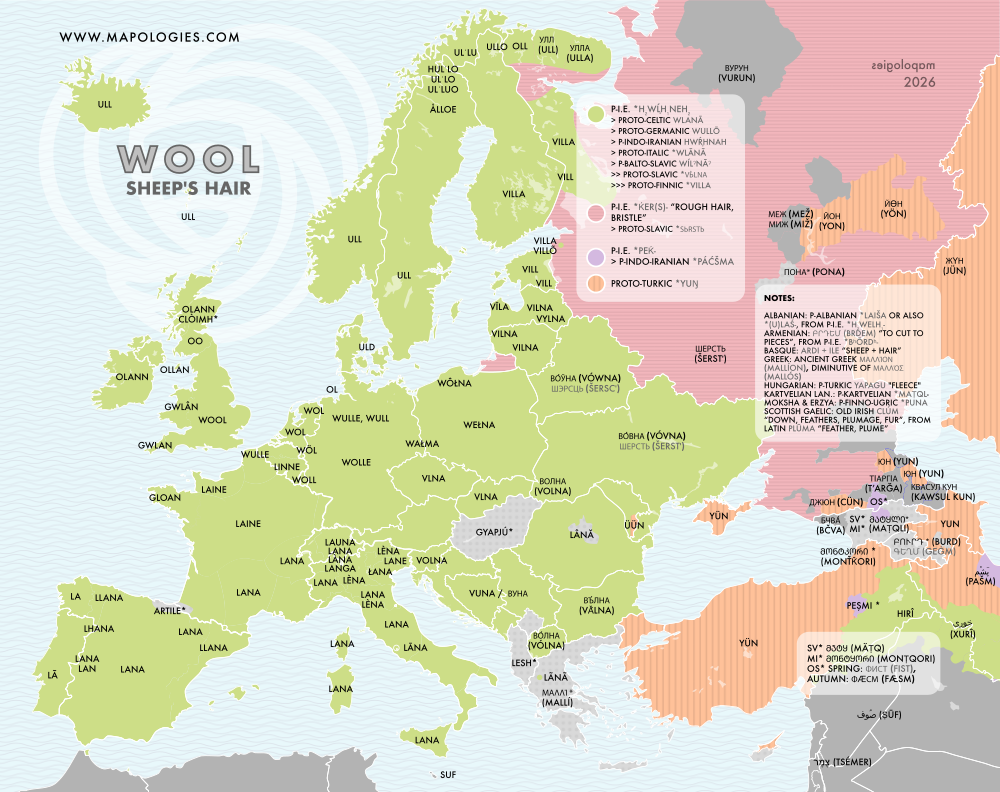
When we used to study Latin, the word lana did not immediately ring a bell. What did it mean? Was it related to the English lane, or somehow connected to land or lens? No—it actually meant wool. At first glance, you might conclude that lana is strictly a Romance word while wool is Germanic, making them completely unrelated. It feels similar to other distinct pairs like the miel versus honey, or lac versus milk, right? Well, to think that would be to pull the wool over your eyes! It turns out that wool and the Latin lana are actually long-lost linguistic cousins. They, along with Ukrainian vovna (вовна) and Kurdish hîrî, all share a single common ancestor: the Proto-Indo-European root *wĺ̥h₂neh₂ (which meant “wool” or “fleece”). Over thousands of years, this one root naturally evolved into different-sounding words as tribes migrated across Europe and Asia.
However, not every language in these regions shares this root. We cannot include: Russian sherst’ (шерсть): This word bypassed the ancient root, developing later from the Proto-Slavic *sьrstь (originally meaning “coarse hair” or “bristle”). Turkish yün belongs to an entirely different language family, descending directly from the Proto-Turkic *jün (meaning “wool” or “hair”).