Herpetón is derived from Ancient Greek (ἑρπετόν) and refers to any creeping animal. In Modern English, it is the root of herpetology, the scientific study of reptiles and amphibians. In this context, we also include animals that were excluded from the classifications of mammals, insects, and birds.
Frog
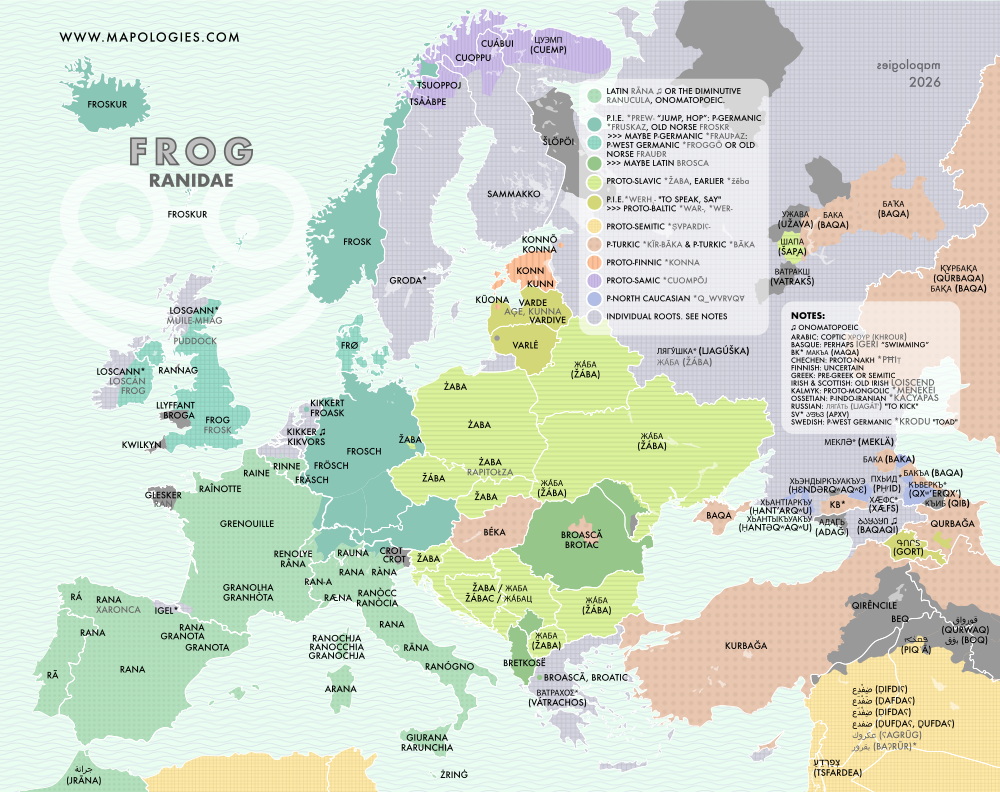
Frog and Danish “Frø” are examples of modern languages that trace their origins back to the ancient Proto-Germanic root *fruskaz. In other Germanic languages, we find similar terms such as the German “Frosch” and Icelandic “froskur”. Probably they are related.
In contrast, in the southern languages, Spanish and Italian “rana,” and even Portuguese “rã” seem to share a common ancestry. But what about French “grenouille” and Catalan “granota”? Yes, they are connected as well. In all these cases, a “g” appears before the diminutive form in Latin, “rānucula.” All these words descend from the Latin rana, which has an onomatopoeic origin. The notable exception are the languages in the Balkans, Romanian and Albanian, both of which share the Latin word brosca. The origin may also be linked again to the Germanic term fruskaz.
In the East, Slavic languages share a common root, Proto-Slavic *žaba, with the notable exception of Russian: The term ljaguska (лягушка) is derived from the verb ljgat (лягать), which means “to kick.”
Lizard
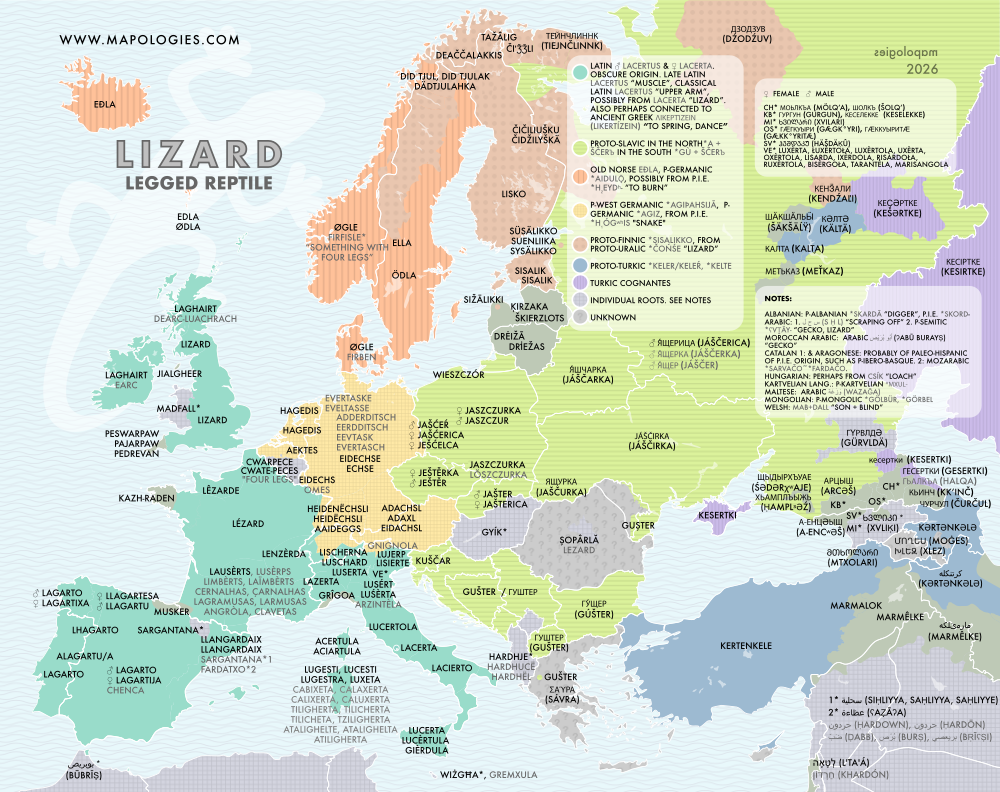
The term “lizard” is used as a general name for legged reptiles, encompassing more than 5,000 species. They can range from only a few millimeters to about 3 meters long. Translations of “lizard” in other languages can therefore be complicated.
English borrowed the word from Latin: lacertus and lacerta. We can see related forms in Spanish and Portuguese, lagarto, and in Italian, lucertola; the closest counterpart is French lézard. Other Germanic languages often use inherited terms from Proto-Germanic. These fall into two groups: in the north, Icelandic edla and Danish øgle result from the evolution of *aidulo. In the south, Dutch hagedis and German Eidechse (or Echse) come from a different word, *agiz.
In the Slavic languages, there is also a north–south split. In this case, Proto-Slavic *aščerъ and *guščerъ share the same root but differ in their prefixes. For example, Slovak jašter and Bulgarian гу́щер (gúšter) reflect these distinct forms.
Snake
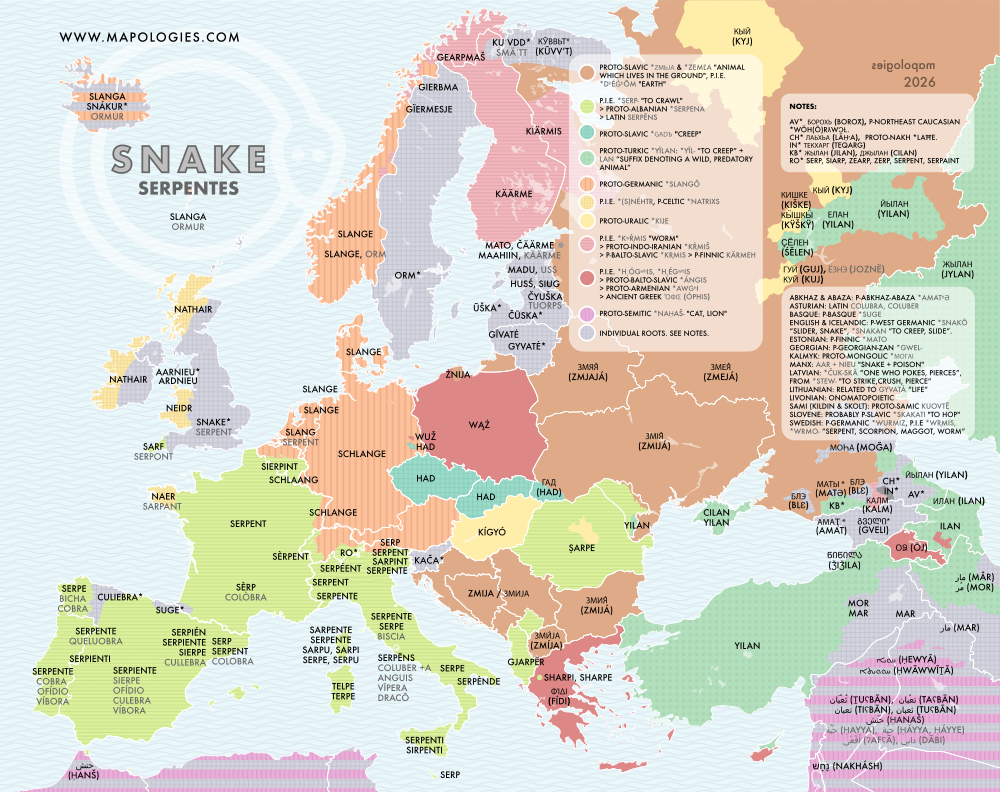
Some people find them captivating; others go so far as to wear their skin. Yet for many of us, snakes are simply creepy. This sense of dread is nothing new—our ancestors felt the exact same way, and the names they gave these creatures reflect that ancient fear. Historically, the words we use for snakes almost always stem from verbs meaning “to crawl” or “to creep.” In Czech and Slovak, the word for snake is “had.” This derives from the Proto-Slavic root “gadъ”, meaning “creep” or an “eerie, disgusting creature.” To early Slavic speakers, this generic term likely bundled reptiles and bugs into one unsettling category.
The English word “snake” follows this exact same pattern. It traces back to the Proto-Germanic verb “sneganą”, which meant “to crawl” or “to creep.” Similarly, ancient Turkic peoples used “yï̄lan” for snake, a word derived from the root “yï̄l-“, which also translates to “to creep.” The scientific name Serpentes comes from the Latin “serpens”, which in turn originated from the Proto-Indo-European root “serp*” meaning “to crawl.” While science kept the formal version, the word adapted naturally into modern languages like Catalan and Maltese, which both use “serp.” Snakes regularly shed their skin, yet their names have endured for millennia without changing their underlying meaning.
On the other hand, the ancient Proto-Indo-European root “h₂éngʷʰis”, which explicitly meant “snake,” has been mostly forgotten. However, it still survives in disguise across three separate and geographically distant language branches: the Polish word “wąż”, the Greek word “φίδι” (fídi), and the Armenian word “օձ” (ōj).
Turtle

Hellish creatures
Let’s discuss turtles and tortoises, as there is considerable debate over the differences between these two terms. Here, however, we will focus on their etymological origin. I can reveal that they share the same root: Late Latin tartarucchus or tartarūchus, derived from the Ancient Greek ταρταροῦχος (tartaroûkhos). From here this etymology becomes particularly interesting, as the Greek term means “holder of Tartaros (or Tartarus)”. Ancient beliefs held that tortoises and turtles originated from the underworld, thought to be the resting place of the dead, referred to as Τάρταρος (Tártaros), meaning “the land of the dead, hell.”
Armed frogs
The speakers of German, Finnish, or Turkish, have noticed that turtles share the same habitat as frogs & toads, primarily along the shores of water bodies. The main distinction is that turtles possess a shell. That is why they coined the compound “shielded frog or toad.” In other Turkic languages, while not exactly the same, a related concept is used: they refer to turtles as “stone frogs.