Crane
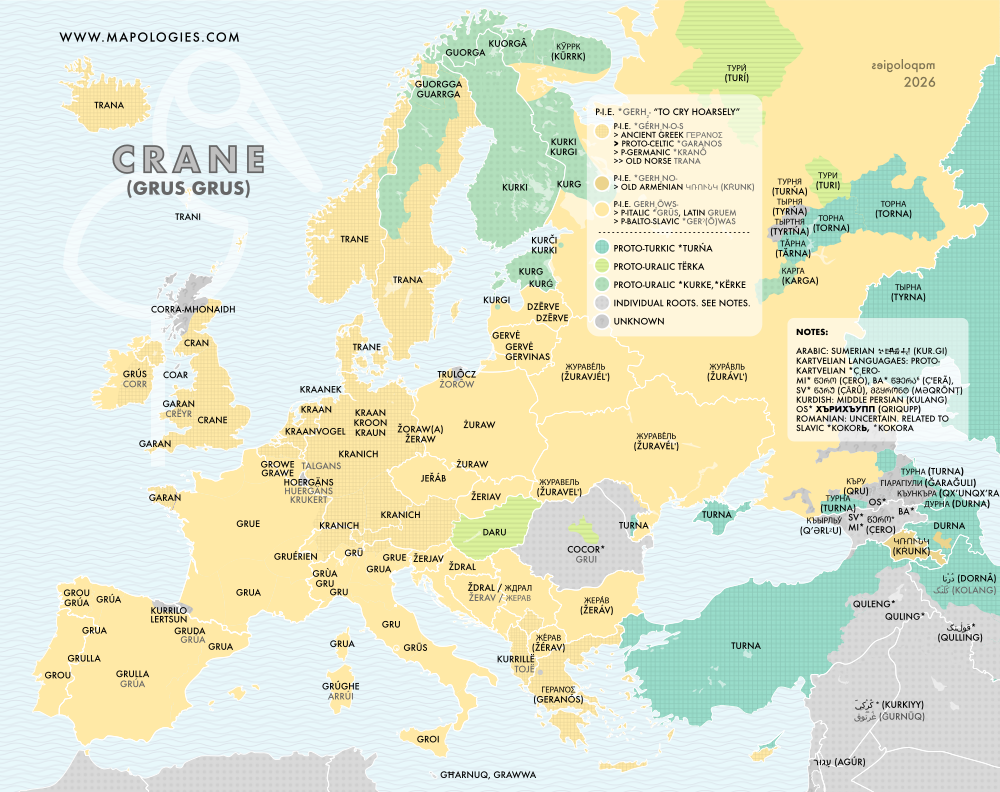
Cranes are known to ornithologists by the scientific name Grus grus, derived from the Latin word grus. Several languages use cognates of the English word crane, including Dutch kraan and German Kranich. Others, such as Italian gru, French grue, and Portuguese grou, derive obviusly from the Latin term. Slavic languages have their own related forms, including Polish żuraw, Croatian ždral, and Russian журавль (žurávlʹ). These diverse Slavic and Romance terms may ultimately be grouped under the reconstructed Proto-Indo-European root *gerh₂ōws. The Germanic form, reconstructed as kranô or a related term, developed separately *gr̥h₂-nés. Both are associated with a root meaning “to cry hoarsely”, gerh₂-, likely onomatopoeic.
Cuckoo

This bird doesn’t have a name, what it has is a sound. Its name is its call. This is an example of onomatopoeia: when a word phonetically imitates, resembles, or suggests the sound it represents. For example, the word “cuckoo” mimics the distinctive call of the Cuculus canorus, the common cuckoo. This pattern appears in many different languages. In some, the onomatopoeic origin is clear and unmistakable; in others, it’s more veiled, having been shaped by phonetic shifts or linguistic evolution over time.
Duck

“What am I seeing here? is it a boat or a duck?”
This situation must have been fairly common in the past, since the etymological origin of the French word for “duck” (canard or cane) comes from a Proto-Germanic term meaning boat or vessel.
However, this kind of semantic shift is very unusual among other languages. Most languages still use words derived from the ancient Proto-Indo-European root: *h₂énh₂t. We find this root spread throughout the West—from the Catalan ànec & ànega in the south, all the way to Icelandic önd in the north—and also in the East as far as Russian утка (utka) in Cyrillic.
Around the Mediterranean, another word for “duck” is also widespread. Its origin may be the Persian bat (بط), but this is uncertain. Variants of it appear in Galician pato & pata, Arabic baṭṭa (بطّة), and Bulgarian патѝца (patitsa) & паток (patok).
Many Slavic languages retain their own inherited word, such as Belarusian качка (kačka) and Slovak kačka. Hungarian kacsa was probably borrowed from one of these. All of these forms ultimately come from an onomatopoetic Proto-Slavic word kačьka (качка).
See also fictional duck characters like Donald Duck and the rest of his family.
Stork
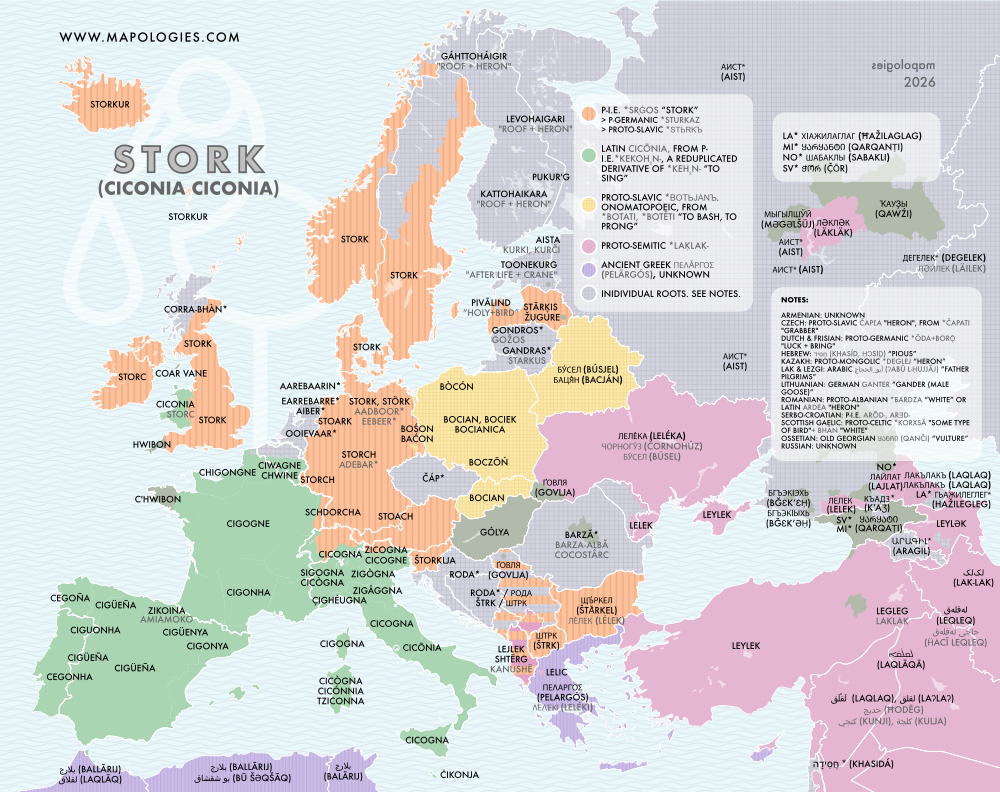
What do the Danish and Swedish word stork mean? Exactly what you’d think: “stork.” It shares deep etymological roots with the German Storch and the Icelandic storkur, all originating from the Proto-Indo-European root *srgos. But this ancient root didn’t just stay in the Germanic family—it also survives today as the Latvian stārķis and the Macedonian штрк (štrk).
The zoological genus for storks, Ciconia, borrows its name directly from Latin. The sonority of this ancient root can still be heard in modern Romance languages like Spanish cigüeña and the French cigogne. Some linguists believe this term was formed through a reduplication of the Proto-Indo-European root *keh₂n-, which translates to “to sing.”
All the Slavic storks
However, the word for stork does not always follow typical language family boundaries. This is especially true within the Slavic language family, where we find up to six completely different etymological roots for the bird: We saw already Macedonian штрк (štrk), and several other South Slavic languages, use a variant of the Proto-Slavic root *stьrkъ, moving northward, we encounter terms derived from the Proto-Slavic *botьjanъ (such as the Polish bocian). This traces back to the verb *botati, meaning “to bash, to prong”.
Other Slavic languages have developed their own entirely unique roots, that in general were borrowed from the name of other birds: Czech čáp evolved from the Proto-Slavic *čapľa “heron.” Serbo-Croatian roda may be connected to the Latin ardea and the Ancient Greek ἐρῳδιός (erōidiós), both of which also translate to “heron.” Russian а́ист (aist) has a heavily debated origin, with some linguists suggesting it was borrowed from Polish hajstra “black stork” and Low German word Heister “magpipe”.
Perhaps the most fascinating case is the Ukrainian word for stork, лелека (leleka). It shares its linguistic origins with several non-Indo-European languages across the Middle East and Asia, including the Turkish leylek, the Arabic لقلق (laqlaq), and the Tatar ләкләк (läkläk). All of these terms originate from the Proto-Semitic root *laqlaq, a clever onomatopoeia designed to imitate the rhythmic clattering sound a stork makes with its beak.
Turkey
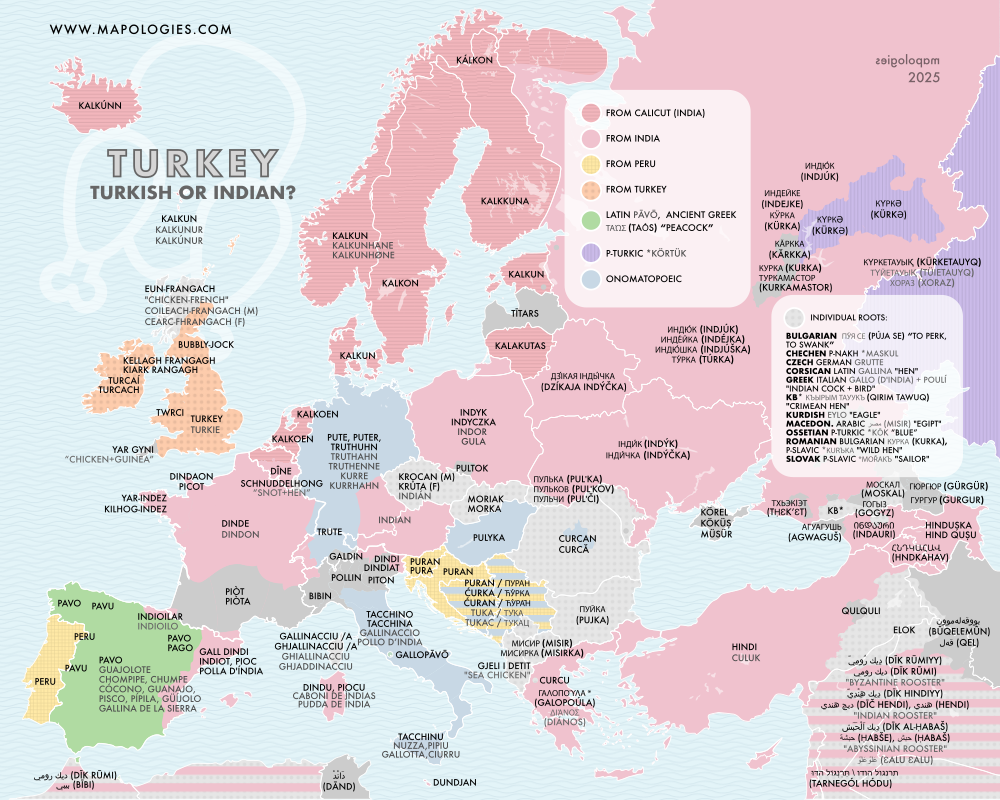
Are turkeys originally from Turkey?
Before we go “talk turkey” on this question, let’s zoom in on the most common name for Meleagris gallopavo: Austrian German Indian, Polish indyk, and Turkish Hindi—plus references like Calicut (a city in India) in parts of Northern Europe. And then it gets even more chaotic: in Portuguese, you might see Peru. The story of turkey is complex:
One: There were no “turkeys” in Europe or Asia. At least not birds.
Two: some kind of bird called “Turkey” existed. It was brought into European trading networks from Africa—so the name traveled “through trade and talk.” In early English you even see “turkey cock” and “turkey hen,” later shortened to “turkey.” But historically, this “turkey” in English didn’t always mean turkey—it sometimes referred to guinea fowl (Numididae), which are native to Africa.
Three: when Europeans encountered the real Meleagris gallopavo, they applied those existing “turkey” names to it, partly because it resembled guinea fowl—so the naming confusion stuck.